
Don't be a tourist, be a traveler, world in motion
Plan a trip
Where the lowlands, the passes and the parks sit
◆ Country guide · Southern Africa

Lesotho, the country that never comes down

The only country on earth that lies entirely above 1,000 metres, wrapped on every side by South Africa and reached over a pass. Lesotho is ridden on a pony, driven in low range and worth the vehicle it asks for.

2M
People
30,355 km²
Area
3,482 m
Highest point
Region
Best months
Apr–May, Sep–Oct
Ideal length
5–8 days
Budget / day
$50–120
Language
Sesotho and English are both official
Getting around
High-clearance hire car, kombis, ponies

When to visit Lesotho

A dry, cold winter when the passes work, and a green summer when they sometimes do not.
Full month guide →
Jan
Feb
Mar
Apr
May
Jun
Jul
Aug
Sep
Oct
Nov
Dec
Best: April, May, September and October, dry, clear and open, on either side of the winter Peak: June to August, cold and bright, the only months with snow and the only ones Afriski runs Good: March and November, the shoulders where the rain is easing or arriving Wet: December to February, storms most afternoons and dirt roads that cannot be relied on
Quick answer · the lowlands, the passes or the snow

Start in Maseru, with Thaba Bosiu half an hour out and the museum at Morija. The central highlands are the reason to come: the A1 and A3 climb to Katse Dam, Semonkong holds the Maletsunyane Falls, and Sani Pass drops off the eastern rim. The north has Afriski and Ts’ehlanyane National Park. The southeast ends at Sehlabathebe. Four days covers Maseru, one pass and one waterfall. A week adds a region and a night in a village by Basotho pony.

1 Lesotho city guide

The country layer comes first here. City guides follow it.

Fun fact

One number worth knowing

Lesotho is the only independent state on earth entirely above 1,000 metres. Its lowest point, where the Makhaleng meets the Senqu near the border, sits at 1,400 metres, the highest low point of any country, and Thabana Ntlenyana reaches 3,482. The Kingdom in the Sky is a plain description.

Stereotypes, sorted out

What the day trip up Sani Pass misses, which roads actually need a 4x4, and why the jacket matters more than the sunscreen.
"It is part of South Africa."

The realityIt is a sovereign kingdom, independent from Britain since 4 October 1966, with its own parliament, monarch and border posts, one of three countries wholly inside another. The ties are close: the loti is pegged to the rand, every road and flight comes from South Africa, and many Basotho work there.

"It is a day trip up Sani Pass."

The realityThat is how most visitors do it, so most see eleven kilometres of gravel, a pub at the top and nothing else. The day tour turns at Sani Top. The Maletsunyane Falls, Katse, Sehlabathebe and a night in a village all lie hours further west. Allow four days at least.

"You need a 4x4 to see anything."

The realityFor some of it. The A1 and A3 are tarred and carry ordinary cars over the high passes, so Maseru, Morija, Thaba Bosiu, Katse and the northern road all suit a hire car. Sani Pass, Sehlabathebe and village tracks need clearance and low range. Plan the route and the vehicle together.

"It is Africa, so pack for heat."

The realityNothing here is below 1,400 metres and most of it is above 2,000. Highland winter nights freeze, snow falls above 2,000 metres in most years, and there is a ski lift for a reason. Summer afternoons are warm until a storm crosses the ridge. A jacket is what first-timers forget and regret.

"The blanket and the pony are put on for photographs."

The realityBoth are working equipment. The Basotho blanket has been everyday outerwear since the nineteenth century, and how it is worn signals occasion and status. The pony reaches villages no vehicle does, and trekking outfits rent the animals that work those paths all week. Ask before photographing either.

The Kingdom in the SkyAfrica's only ski resortThe timeless herdboySani Pass is the countryThe poorest country aroundJohannesburg's water tower

How to behave

  • Greet before you ask. Lumela to one person, lumelang to a group, and a moment on how someone is doing before you get to the question. Skipping it reads as rudeness in a way it does not in Maseru's offices but very much does in a village.
  • Ask before photographing anyone, and expect no to be a real answer. Herdboys in blankets are the most photographed people in the country and are rarely asked.
  • A flag on a pole outside a homestead means something is for sale that day: white for joala, the sorghum beer, yellow for maize beer, red for meat, green for vegetables. It is a shop sign, not a decoration, and walking in is the normal way to use it.
  • Chiefs still matter. In a village, the courtesy is to greet the chief or the headman before wandering, and a pony trekking operation will usually arrange that for you without being asked.
  • Cover up. Shorts on an adult read as beachwear in a country where the weather rarely allows them, and a blanket over the shoulders is the local answer to cold in a way a fleece is not.
  • Do not treat the monarchy as folklore. The king is head of state, the role is constitutional, and Lesotho has had coups, a 1998 intervention by its neighbours and several unstable parliaments in living memory. Basotho discuss all of it; follow their lead and do not open with it.

Famous Basotho faces
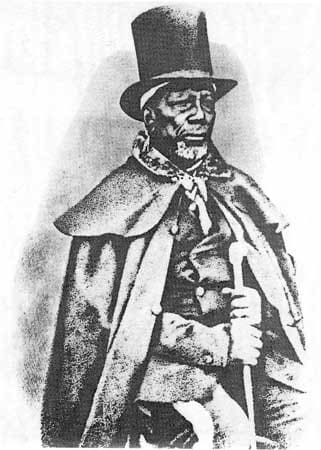
The king who was never taken off his mountain, the novelist who made Sesotho a literary language, the Village Pope, and a marathon runner who trains at 2,000 metres by default. Pick a field.
Moshoeshoe I, Lesotho (portrait via Wikimedia Commons)

Moshoeshoe I

Founded the Basotho nation on Thaba Bosiu from 1824, and won British protection in 1868.
Lemohang Jeremiah Mosese, Lesotho (portrait via Wikimedia Commons)

Lemohang Jeremiah Mosese

Director of This Is Not a Burial, It’s a Resurrection, Lesotho's first Oscar submission.
Letsie III

Letsie III

Constitutional king since 1996, who first held the throne from 1990 to 1995.
Moshoeshoe II

Moshoeshoe II

King at independence in 1966, exiled in 1990, restored in 1995, killed in a crash in 1996.
Thomas Mofolo

Thomas Mofolo

The first major Sesotho novelist, whose Chaka (1925) is a classic of African literature.
Mpho 'M'atsepo Nthunya

Mpho 'M'atsepo Nthunya

Wrote Singing Away the Hunger (1996), the best-known account of ordinary Basotho life.
Tsepo Tshola

Tsepo Tshola

The Village Pope (1953 to 2021), Sankomota's frontman and the country's biggest voice.
Frank Leepa

Frank Leepa

Guitarist and co-leader of Sankomota, the first Lesotho band heard widely abroad.
Mosito Lehata

Mosito Lehata

Sprinter who holds the national 100 metres record at 10.11 seconds, in a distance nation.
Neheng Khatala

Neheng Khatala

Olympic marathoner in Tokyo who won the Soweto Marathon in November 2024.
Sam Matekane

Sam Matekane

Mining tycoon, prime minister since October 2022, seven months after founding his party.

Must-try Basotho food

Maize in five forms, four breads cooked four ways, soured milk poured over the lot, and a sorghum beer you buy by reading a flag. Pick a category.

Papa

Stiff maize porridge, eaten by hand with a relish. Everything else is served against it.

Moroho

Greens cooked down with onion over papa. Papa le moroho is the plate the country runs on.

Likhobe

Whole maize or sorghum kernels boiled soft and salted. Plain, filling and a base for more.

Nyekoe

Sorghum slow-cooked with beans and made for a crowd. It tastes of the highlands.

Motoho

Sour sorghum porridge, fermented overnight and drunk warm from a mug at breakfast.

Makoenya

Fat cakes: wheat dough fried until golden, sold from buckets at every taxi rank.

Liphaphatha

Flat wheat bread cooked in a pot on the coals. Dense, smoky, and it travels on a pony.

Maqebekoane

Dumplings steamed in the pot over a stew, taking its flavour. Sunday food.

Bohobe ba polata

Bread baked in a cast-iron pot with coals heaped on the lid. The crust is the point.

Lebese

Soured milk, drunk alone or poured over hot papa. Every household has a view on it.

Highland trout

Farmed in the cold reservoirs of the Highlands Water Project and grilled whole.

Joala

Homestead sorghum beer. A white flag outside a house means a batch is ready to buy.

Lesotho travel FAQ

Do I need a visa for Lesotho?+
Most Western passports do not for a short visit. British nationals, for example, can stay up to 90 days without one, and the stay is extendable at the visa application centre in Maseru. Your passport needs to be valid for at least 90 days beyond arrival and to have several blank pages, because you will be stamped in and out of South Africa as well. Check your own nationality against the Lesotho immigration authorities before booking, because the rules have been moving: a visa exemption for all EU citizens was agreed in May 2026.
How do I actually get there?+
Through South Africa, without exception. There is no other neighbour. By air that means Johannesburg, then the short hop into Moshoeshoe I International outside Maseru, which is the airport’s only scheduled route. By road it means one of the border posts, most of them from the Free State side: Maseru Bridge, opposite Ladybrand, is the busiest and is open around the clock, and Sani Pass in the east is the most spectacular and the most restricted. Whichever way you come, you need to satisfy South Africa’s entry rules as well as Lesotho’s, and a hire car crossing the border needs a letter of authority from the rental company.
Is Lesotho safe to visit?+
The US State Department rates it Level 2, exercise increased caution, for crime. Armed robbery, carjacking and residential break-ins happen, petty theft is common in the towns, and police response can be slow, so the ordinary rules apply harder than usual: nothing on show, no walking around Maseru after dark, and a taxi at night. The bigger everyday risk is the road. Passes are steep, mist comes down fast, livestock stand in the carriageway, and driving after sunset is the single thing worth designing out of an itinerary. Outside the towns the country is calm and hospitality is close to a rule.
Do I need a 4x4?+
It depends where you are going, and it is worth deciding before you book. The A1 and A3 run the length of the country on tar and take an ordinary hire car over passes above 3,000 metres, which covers Maseru, Morija, Thaba Bosiu, Katse and the northern pass road. Sani Pass, Sehlabathebe, most of the Senqu valley and any village track are the other half, and there you want high clearance, low range and someone who has driven it before. Snow and ice close high sections at short notice in winter, and there is no gritting service.
When should I go?+
April to May and September to October are the two windows where the weather is dry, the passes are open and the walking is comfortable. June to August is cold, clear and the only time there is snow, which is the season if Afriski or a frozen highland landscape is the point. November to March is the rain: green, dramatic, and the months when storms flood river crossings, close dirt roads and cut visibility on the passes. Nothing here is a heat question. It is an altitude question.
What does it cost, and what money do I use?+
The loti is pegged one to one with the South African rand, and rand notes are legal tender everywhere in Lesotho, so there is no real currency problem arriving overland. Maloti are not accepted in South Africa, which is the direction that catches people out, so spend or change them before you cross back. Cards work in Maseru and at the bigger lodges and are much less reliable in the highlands, where cash is the assumption. Costs sit below South African levels for food and transport and level with them at the handful of lodges that visitors mostly use.

Planning a Lesotho trip?

One fully-researched destination (ranked, mapped and paired with video) in your inbox every Thursday.

Photo credits (2)