Don't be a tourist, be a traveler, world in motion
Plan a trip
Live destination map
◆ Country guide · South Asia

Pakistan, the Karakoram and the Indus

Pakistan holds five of the world's fourteen mountains above 8,000 metres, and the Mughal capitals sit at the other end of the same road. It is really two countries to travel: the Karakoram in the north, and the Indus plain and its cities in the south. Season and paperwork decide which one you get.

241M
People
796,096 km²
Area
Region
Pakistan, Wimup country guide
Haleem, Pakistan (Wimup)Haleem
Naan and roti, Pakistan dish (Wimup)Naan and roti
Best months
May–Oct north, Nov–Mar plains
Ideal length
12–16 days
Budget / day
$40–160
Language
Urdu is national and English official
Getting around
Flights to Gilgit

When to visit Pakistan

Two calendars in one country. The mountains open as the plain becomes unbearable, and close as it becomes pleasant.
Full month guide →
Jan
Feb
Mar
Apr
May
Jun
Jul
Aug
Sep
Oct
Nov
Dec
Best: March, April, September and October, the shoulders that work in the mountains and on the plain at once Peak: July and August, the trekking and climbing season above the monsoon, and the busiest weeks in the north Good: January, February, May, June and November, when one half of the country is at its best and the other is closed Quietest: December, cold and smoggy on the plain and snowbound in the north
Quick answer · the mountains or the plain

Most trips take one half properly and give the other a few days. The north is the Karakoram, open May to October: fly Islamabad to Gilgit, then Karimabad in Hunza for the forts and Rakaposhi, Skardu for Baltistan, and the Khunjerab Pass at 4,693 metres. The south is best November to March: Lahore for the Mughal city, Multan for the Sufi shrines, Sindh for Mohenjo-daro and Karachi. Islamabad and Rawalpindi are the hinge. Permits and province-by-province travel advice shape the plan.

Fun fact

One number worth knowing

Pakistan holds five of the fourteen mountains above 8,000 metres, K2 at 8,611 metres among them. Four ring the Baltoro Glacier, and Concordia, where the Godwin-Austen Glacier joins it, sees them all at once. It is days on foot from the last road, so the view is famous and photographs are rare.

Stereotypes, sorted out

What the news flattens, what the country is actually like, and how to behave once you land.
"Pakistan is a desert."

The realityIt has a coastline on the Arabian Sea, irrigated plain across the Punjab, subtropical forest in the northeast, real desert in the Thar and Balochistan, and some of the largest glaciers outside the polar regions. The Baltoro alone runs more than 60 kilometres.

"The whole country is off limits."

The realityThe advice is drawn province by province. Foreign ministries advise against all travel to Balochistan and against travel to much of Khyber Pakhtunkhwa, but treat Gilgit-Baltistan, the Punjab, Islamabad and Karachi differently. Read the current wording. Defying an advisory usually voids insurance.

"Pakistan and India are interchangeable."

The realityThey share the Punjab, the Grand Trunk Road and a great deal of the food, and they were one territory until 1947. They are also two states with different official languages, different scripts for the languages they do share, and a land border that is closed to most travellers.

"Women cannot travel there."

The realityWomen travel in Pakistan, independently and in groups, and Pakistani women work, drive and study across the country. Dress is conservative by convention and a scarf is expected at shrines and mosques. The practical advice is about clothing, transport and where you stay, not about whether to come.

"It is all mountains and mosques."

The realityThe oldest layer is neither. Mohenjo-daro was a planned city with drains and a grid around 2500 BC, Taxila was a Gandharan Buddhist centre on a Greek plan, and Takht-i-Bahi is a monastery. Four of the six World Heritage properties here predate Islam in the region.

Snow peaks in mirror lakesThe Khunjerab border selfieBadshahi Mosque at sunsetPainted trucks as folk artK2 as an afternoon walkChai poured from a height

How to behave

  • Hospitality is close to obligatory and refusing it outright is the awkward move. Expect to be fed, expect the bill to be fought over, and expect to lose that fight. Reciprocating another day is the graceful answer.
  • Dress conservatively. Shoulders and knees covered for everyone, and a shalwar kameez is cheap, cool and completely unremarkable to wear. Women should carry a scarf for mosques and shrines.
  • Ask before photographing people, and do not photograph women, military installations, checkpoints, bridges or airports. The last group is taken seriously.
  • Friday midday prayers empty the shops and slow the roads in most cities. Plan around them.
  • Ramadan reshapes the working day. Kitchens close through daylight in much of the country, hours shift, and eating, drinking or smoking in public during fasting hours is an offence under the Ehtram-e-Ramazan Ordinance.
  • The left hand is not used for eating or for handing things over. Food is often eaten with the right hand and a piece of bread, without cutlery. Follow the table you are at.
  • Alcohol is not sold openly to Muslims and is restricted for everyone else. Non-Muslim foreigners can buy it through a permit room in some hotels. Plan a dry trip and treat anything else as a bonus.

Famous Pakistani faces

A founder, two Nobel laureates, a squash record nobody has come near, and the voice that carried qawwali out of the shrines. Pick a field.
Muhammad Ali Jinnah, Pakistan (portrait via Wikimedia Commons)

Muhammad Ali Jinnah

Led the Muslim League to Pakistan's creation in 1947. Quaid-e-Azam, on the currency.
Benazir Bhutto, Pakistan (portrait via Wikimedia Commons)

Benazir Bhutto

First woman to lead a Muslim-majority country's government, in 1988. Killed in 2007.
Abdus Salam, Pakistan (portrait via Wikimedia Commons)

Abdus Salam

Physicist from Jhang who shared the 1979 Nobel, the first Muslim science laureate.
Malala Yousafzai, Pakistan (portrait via Wikimedia Commons)

Malala Yousafzai

Shot in Swat in 2012 for campaigning for girls' education. Nobel Peace Prize at seventeen.
Abdul Sattar Edhi, Pakistan (portrait via Wikimedia Commons)

Abdul Sattar Edhi

Built the country's main ambulance network from one Karachi stall, on no salary.
Imran Khan, Pakistan (portrait via Wikimedia Commons)

Imran Khan

Captained Pakistan to the 1992 Cricket World Cup. Prime minister from 2018 to 2022.
Jahangir Khan, Pakistan (portrait via Wikimedia Commons)

Jahangir Khan

Six World Open titles, and unbeaten in competitive squash for over five years from 1981.
Wasim Akram, Pakistan (portrait via Wikimedia Commons)

Wasim Akram

Left-arm spearhead of the 1992 World Cup side, first to 500 one-day international wickets.
Nusrat Fateh Ali Khan, Pakistan (portrait via Wikimedia Commons)

Nusrat Fateh Ali Khan

The qawwal who carried Sufi devotional singing from the Punjab shrines to the world.
Abida Parveen, Pakistan (portrait via Wikimedia Commons)

Abida Parveen

Leading living singer of Sufi kalam, filling stadiums with Bulleh Shah and Bhittai.
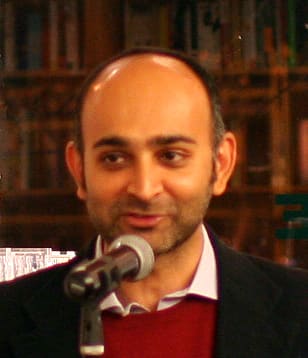
Mohsin Hamid, Pakistan (portrait via Wikimedia Commons)

Mohsin Hamid

Lahore novelist. The Reluctant Fundamentalist and Exit West were both Booker-shortlisted.
Allama Muhammad Iqbal

Allama Muhammad Iqbal

Poet whose Urdu and Persian verse gave the idea of a Muslim state its language.
Sadequain

Sadequain

Painted the Frere Hall ceiling in Karachi and made Quranic calligraphy modern murals.

Must-try Pakistani food

A breakfast stew eaten at dawn, a wok of meat served in its own pan, mustard greens under butter, and bread bigger than the plate. Pick a category.
Haleem, Pakistan (Wimup)

Haleem

Wheat, barley, lentils and meat cooked for hours to a thick paste. A Ramadan fixture.

Naan and roti, Pakistan dish (Wimup)

Naan and roti

Roti is the everyday wholemeal round, naan the leavened oval. Both come with everything.

Nihari

Shank stewed overnight in spiced gravy, eaten at breakfast with naan, ginger and chilli.

Karahi

Chicken or mutton cooked hard in a wok with tomato, ginger and chilli, served in the pan.

Saag with makai roti

Mustard greens slow-cooked and buttered, with a maize flatbread. A Punjabi winter dish.

Chapli kabab

Peshawar's flat minced-beef patty with tomato and pomegranate seed, griddle-fried.

Seekh kabab

Spiced mince on skewers over charcoal. The tandoor order to judge a place by.

Sindhi biryani

Layered rice with meat, yoghurt and potato, sour and hot. The potato is not optional.

Kabuli pulao

Mutton rice cooked in stock with whole spice, carrot and raisin. Peshawar does it best.

Chana chaat

Chickpeas, potato, onion and tamarind, sharp and cold. The standard way to break a fast.

Golgappa

Hollow crisp spheres filled with spiced water and potato, eaten whole in one bite.

Sohan halwa

Multan's dense disc of ghee, sugar, nuts and sprouted wheat, sold by the boxed slab.

Falooda

Rose syrup, vermicelli, basil seed, ice cream and milk in a tall glass. Summer in a glass.

Kashmiri chai

Pink salt tea with milk and crushed nuts. Everywhere in Gilgit-Baltistan.

Lassi

Yoghurt blended with ice and salt or sugar, drunk by the pint through the Punjab summer.

Know before you go

The essentials for planning a Pakistani trip: the visa, the permits, the money, the seasons and the roads.
Currency

Pakistani rupee (PKR)

Cash rules outside big hotels and malls. ATMs are common in cities and rare in the mountains, so draw cash before leaving Gilgit or Skardu. Cards work mainly in Islamabad, Lahore and Karachi.

Language

Urdu is national, English is official

Urdu is the shared language of school and broadcast, with English in government and on signs. Punjabi is the largest first language, with Pashto, Sindhi, Saraiki and Balochi regionally.

Visa

Apply at visa.nadra.gov.pk

The National Database and Registration Authority runs the only official online visa system, visa-on-arrival categories included. Rules change, so read the portal itself.

Permits and registration

Required in several regions

Register locally in Gilgit-Baltistan. Above 6,000 metres you need a permit that takes up to two months. Khyber Pakhtunkhwa, Balochistan and parts of Azad Kashmir need advance permission.

Travel advice

Regional, and revised often

Advisories are drawn province by province and change often. Check your government's current page before booking. Travelling against one usually voids your insurance.

Power

230V, 50Hz, plug types C and D

Type C is the two-pin Europlug and type D has three large round pins, so bring a universal adapter. Scheduled power cuts are routine, and most hotels run a generator.

Emergency

15 police · 1122 rescue · 16 fire · 115 ambulance

Rescue 1122 covers Punjab, Khyber Pakhtunkhwa, Gilgit-Baltistan and Azad Jammu and Kashmir. The Edhi Foundation runs the largest ambulance network, free, on 115.

Getting around

Fly the long legs, coach the Punjab

Flights link Islamabad with Gilgit, Skardu and Karachi and save two days, but the northern routes cancel in bad weather. Coaches run the Punjab, trains the Indus, jeeps the mountains.

Dress

Conservative, and easier than it sounds

Shoulders and knees covered for everyone, and a shalwar kameez is cheap and cool. Women should carry a scarf for mosques and shrines. In most streets a headscarf is not expected.

Tipping

Customary, not automatic

Round up taxi fares, tip in restaurants where service is not added, and tip trek porters and drivers per day at the rate your operator sets. Carry small notes for it.

Alcohol

Restricted

Alcohol is not sold openly to Muslims, and it is restricted for everyone else. Non-Muslim foreigners can buy it through a permit room in some hotels. Plan a dry trip.

Pakistan travel FAQ

Is it safe to travel in Pakistan?+
It depends entirely on where. Foreign ministries advise against all travel to Balochistan and against travel to much of Khyber Pakhtunkhwa, and they treat Gilgit-Baltistan, the Punjab, Islamabad and Karachi very differently from those. Travel in the restricted provinces needs advance permission and sometimes a No Objection Certificate from the Ministry of Interior. Read your own government’s current page before booking, because the wording is revised often, and note that travelling against an advisory usually invalidates travel insurance.
Do I need a visa, and how do I get one?+
Almost everyone does. Applications go through the government's own portal at visa.nadra.gov.pk, run by the National Database and Registration Authority, which also handles the visa-on-arrival categories. It is the only official channel: no other site is authorised, whatever it looks like. Eligibility and processing times change, so read the portal itself.
When should I go?+
The country does not have one answer. The Karakoram works from roughly May to October and is closed by snow either side, with July and August the busiest and the most reliable for high trekking. The plains run the other way: Lahore, Multan and Sindh are at their best from November to March, and May to August down there is punishing. March, April, September and October are the months that half-work at both ends.
Do I need permits for the mountains?+
Foreign nationals register with the local authorities on arrival in Gilgit-Baltistan, which is routine. Anything above 6,000 metres needs a mountaineering or trekking permit. The process can take up to two months, and a licensed company should arrange it.
How do I get around?+
Fly the long legs. Islamabad to Gilgit or Skardu turns two hard days on the Karakoram Highway into about an hour, though those flights fly on sight of the ground and cancel often. Between the Punjab cities the motorway coaches are fast and comfortable. Trains run the length of the Indus, slowly, and show you the country. In the mountains it is shared jeeps and hired 4x4s.

Planning a Pakistani trip?

One fully-researched destination (ranked, mapped and paired with video) in your inbox every Thursday.

Photo credits (13)