Lithuania, the dunes and the lake country behind them
The largest of the three Baltic states, and the one with the longest memory. A baroque capital that tolerates a self-declared republic of artists inside it, a sand spit that moves with the wind, and a grand duchy behind all of it that once reached the Black Sea.
1
City guide
2,890,700
People
65,286 km²
Area
Region
Best months
May–Sep
Ideal length
7–10 days
Budget / day
$60–150
Language
Lithuanian, with English widely spoken in the cities
Getting around
Trains between Vilnius, Kaunas, Klaipėda and Šiauliai, intercity coaches everywhere else, and a car for the lakes and the villages
When to visit Lithuania
A long bright half the whole country plans around, and a dark half worth going for different reasons.
Best: May, June and September, the long-light months, warm enough and not yet booked Peak: July and August, when the sea is swimmable and the coast runs full Good: March, April, October and December, shoulder weather with a festival attached Quietest: January, February and November, dark and cold, and the country at its cheapest
Quick answer · the capital, the coast or the lakes
Lithuania is a capital, a short coast and a lot of forest in between, and almost every first trip starts in the same place. Vilnius holds the baroque old town, the hill above it and Užupis across the river, and it earns three or four nights on its own, with Trakai and the mounds at Kernavė as half-day trips out of it. Kaunas is the counterweight in the centre: the interwar capital, and the modernist streets UNESCO listed in 2023. The coast is the second half of most itineraries, reached in a few hours by train. Klaipėda is the port and the crossing point, Nida sits out on the Curonian Spit under the dunes, and Palanga is where the country goes to swim. The north is a detour rather than a base, with Šiauliai and the Hill of Crosses the reason to make it. The eastern lakes around Ignalina and the pine forest of Dzūkija in the south are the slow half of the country, and both are far easier with a car. A week does Vilnius, the coast and one of the two.
The geographical centre of Europe sits 26 kilometres north of Vilnius, in a field outside the village of Purnuškės. Scientists at the French National Geographic Institute worked it out in 1989 using a centre-of-gravity method applied to the continent’s outline, Guinness World Records accepted the result, and a granite pillar with a crown of stars now stands on the spot. Several other countries claim the same title on other methods, which is the honest footnote: the centre of a continent depends entirely on where you agree the continent stops.
Stereotypes, sorted out
What gets flattened into one Baltic paragraph, what the country is actually like, and how to behave once you land.
"Lithuania is basically Latvia with a different flag."
The realityLithuanian and Latvian are the only two Baltic languages left alive, they are related, and a speaker of one cannot follow the other. Lithuania is Catholic where Latvia and Estonia are historically Lutheran. And Lithuania has a medieval empire behind it that neither of the others does. Grouping the three is a convenience of the airline map, not a description of them.
"A small country with a small history."
The realityThe Grand Duchy of Lithuania was the last pagan state in Europe, converted in 1387, and in the fifteenth century it stretched from the Baltic toward the Black Sea, which made it one of the largest states on the continent. The union with Poland ran for centuries and ended with the country partitioned off the map entirely between 1795 and 1918. That vanishing is why the language, the songs and the wooden crosses were guarded so carefully afterwards.
"Everyone speaks Russian, so open in Russian."
The realityLithuanian is the state language and the one on every sign. Russian is widely understood by older speakers, and a great many of them will answer you in it, but the occupation ended in 1991 and is inside living memory, so leading with Russian lands badly. Open in English, which anyone under fifty is likely to speak, and let the other person choose the language.
"It is cold, grey and permanently dark."
The realityHalf true, half backwards. November to February is genuinely dark and the days are short. June and July are the opposite: the evenings barely go properly dark, the Baltic warms just enough to swim in by August, and the entire country moves outdoors between May and September. The complaint locals actually have is about the length of the winter, not the depth of it.
"There is nothing beyond Vilnius."
The realityVilnius is the reason most people come and it deserves the days. It is also about a fifth of the country's population and a small fraction of the map. Kaunas holds one of the largest bodies of interwar modernism in Europe, the Curonian Spit is a UNESCO site that behaves like a desert with a sea on each side, and the eastern lakes and the Nemunas Delta are as good as northern Europe gets for water and birds. A trip that never leaves the capital has seen a city, not a country.
A drone shot of Gediminas hill at sunset, standing in for a country of nearly three million people.Amber photographed like jewellery in a window, with nothing said about where on the coast it washes up or why.The Hill of Crosses shot from above at golden hour, in an article that never mentions why it kept being bulldozed.A hoop nailed to a barn wall, captioned as proof that basketball is a religion, by a writer who never went to a game.Cepelinai photographed grey on a white plate, which is exactly how not to sell the national dish.A Soviet statue at Grūtas Park used as evidence of nostalgia, when the park exists precisely because nobody wanted the statues left standing in the squares.
How to behave
Shoes come off inside a home, without discussion, and slippers are usually offered. Keeping them on reads as a small rudeness rather than an oversight.
Flowers are given in odd numbers. Even numbers are for graves and funerals, and this is one of the rules nobody bends.
Basketball is a real conversation rather than a joke about one. The country has three European titles and three Olympic bronzes, and the Žalgiris and Rytas rivalry is where the temperature is.
The public register is quiet. Voices carry low on trains and in restaurants, small talk with strangers is brief, and warmth arrives once you are past the first meeting rather than at it.
Occupation is recent history, not distant. The Soviet period ended in 1991 and almost every family has a deportation, a partisan or an emigration in it. Treating the era as retro decor is the misstep visitors most often make.
Late summer belongs to the forest. Mushroom and berry picking is a national pastime, entire weekends go to it, and asking someone where they pick is roughly as personal as asking a fisherman for a spot.
Famous Lithuanian faces
A centre who changed how big men pass, a fifteen-year-old Olympic champion, the violinist of the last century, and the archaeologist who rewrote European prehistory. Pick a field.
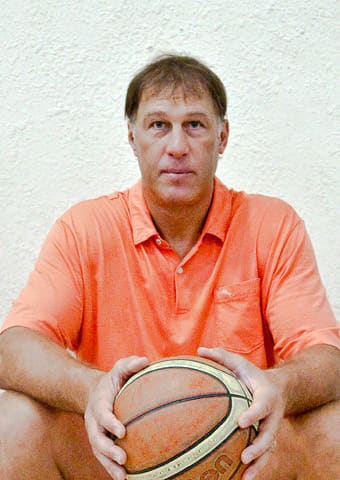
Arvydas Sabonis
Arvydas Sabonis
The centre who won Olympic gold with the Soviet Union in 1988 and then took bronze three times with an independent Lithuania. He reached the NBA at Portland in 1995, past his physical peak and still one of the most gifted passing big men the sport has produced.
Šarūnas Marčiulionis
One of the first players from behind the Iron Curtain to hold a regular NBA role, at Golden State. He organised and funded the 1992 national team when the new state could not, and the tie-dyed kit that came out of it is the most famous thing Lithuanian sport has ever worn.
Jonas Valančiūnas
A long-serving NBA centre and the anchor of the national team through a decade of tournaments, the player most responsible for Lithuania staying competitive with countries many times its size.
Domantas Sabonis
Arvydas's son, an NBA All-Star and one of the league's leading rebounders. He plays for Lithuania, which makes the Sabonis name a two-generation fixture in the same national shirt.
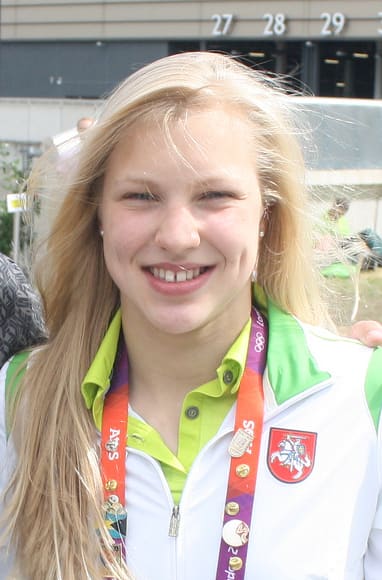
Rūta Meilutytė
Won Olympic gold in the 100 metres breaststroke at London 2012 at the age of fifteen, and has held world records in the sprint breaststroke events since. She carried Lithuanian swimming through its best decade.
Virgilijus Alekna
Two Olympic discus golds, at Sydney in 2000 and Athens in 2004, plus world titles. For a generation he was the answer to what Lithuania did outside a basketball hall.
Mikalojus Konstantinas Čiurlionis
Mikalojus Konstantinas Čiurlionis
Painter and composer, dead at 35 in 1911, and the closest thing the country has to a national artist. His symbolist canvases and his tone poems were doing similar work at the same time, and the museum holding most of them is in Kaunas.
Jurgis Mačiūnas
Jurgis Mačiūnas
Known abroad as George Maciunas, the founder and organiser of Fluxus, the international art movement of the 1960s that treated the event, the joke and the mail-order catalogue as legitimate art forms.
Jonas Mekas
Poet, diarist and film-maker who left as a displaced person after the war and became a central figure of American avant-garde cinema, co-founding Anthology Film Archives in New York.
Šarūnas Bartas
The director who put Lithuanian cinema on the festival circuit after independence, working in long takes and near-silence, and the reference point every younger Lithuanian film-maker is measured against.
Czesław Miłosz
Czesław Miłosz
Born in 1911 at Šeteniai, in what is now central Lithuania, and awarded the Nobel Prize in Literature in 1980. He wrote in Polish and spent a lifetime writing about this landscape, which is why both countries claim him and neither is wrong.
Emmanuel Levinas
Born in Kaunas in 1906 and one of the major moral philosophers of the twentieth century, whose work puts the face of another person at the foundation of ethics.
Romain Gary
Romain Gary
Born in Vilnius in 1914, later a French aviator, diplomat and novelist, and the only writer to win the Prix Goncourt twice, having taken the second under an invented name.
Rūta Šepetys
Rūta Šepetys
The Lithuanian American novelist whose Between Shades of Gray put the Soviet deportations to Siberia in front of a young international readership, and who has kept writing the histories that got buried.
Jascha Heifetz
Jascha Heifetz
Born in Vilnius in 1901 and, by wide agreement, the violinist of the twentieth century. His recordings are still the reference for most of the repertoire he touched.
Vytautas Landsbergis
A musicologist who led the Sąjūdis independence movement and became head of state when Lithuania declared independence from the Soviet Union on 11 March 1990, the first republic to do so.
Dalia Grybauskaitė
President from 2009 to 2019, the first woman to hold the office and the first to be re-elected, and the voice that made the country audible in Brussels well beyond its size.
Marija Gimbutas
The archaeologist who reconstructed the prehistory of Europe from its burials and its pottery, and whose Kurgan hypothesis on the spread of the Indo-European languages is still the argument the field has.
Must-try Lithuanian food
Potato in every form the cold ever demanded, a cold pink soup that owns the summer, rye bread fried with garlic, and honey fermented since before the country was Christian. Pick a category.
Cepelinai
Grated potato moulded around minced pork into two heavy zeppelins, boiled and served under sour cream and bacon. The national dish, and a lunch that ends most people's plans for the afternoon.
Šaltibarščiai
Cold beetroot and kefir soup, an almost fluorescent pink, with dill, cucumber and egg through it and a hot boiled potato served alongside. It appears the week the weather turns and disappears in September.
Kugelis
Grated potato baked with bacon and onion into a dense slab, crisp at the edges. Sour cream is not optional and lingonberry jam is the argument.
Kibinai
Crimped pastry turnovers filled with mutton and onion, brought by the Karaim community that settled at Trakai in the fourteenth century. Buy them on the way to the castle rather than after.
Kepta duona
Dark rye bread cut into sticks, fried, rubbed with garlic and buried in grated cheese. The default thing to order with beer, and the reason a Lithuanian bar smells the way it does.
Vėdarai
Potato sausage: grated potato and bacon packed into casings and baked until the skin splits. Heavy, old, and much better than the description suggests.
Šaltiena
Pork set in its own jelly, sliced cold and eaten with horseradish and mustard. A holiday table fixture, and the dish visitors are most often dared into.
Šimtalapis
The hundred-layer cake of Dzūkija, poppy seed rolled through thin dough again and again. Southern, laborious, and a good reason to stop in Druskininkai.
Žagarėliai
Thin ribbons of dough knotted, fried and dusted with sugar, shattering as soon as you pick one up. Shrovetide food that stayed on the menu all year.
Bulviniai blynai
Potato pancakes fried until the lace at the edge goes brittle, eaten plain with sour cream or filled with meat and turned into a main course.
Kastinys
The Samogitian one: sour cream churned with salt until it thickens into something between butter and a dip, then eaten with hot potatoes. Rarely found outside the west of the country.
Skilandis
Coarsely minced pork packed tight, smoked over alder and then air-dried for months. The name carries EU protected status, so what is sold under it has to be made the long way.
Balandėliai
Cabbage leaves rolled around minced meat and rice and stewed in tomato. Every family cooks them and every family insists their version is the correct one.
Juoda ruginė duona
Dark sourdough rye, sour, dense and closer to a food than a side. It anchors the whole cuisine, and it is the loaf most emigrants ask their relatives to post.
Rūkyta ungurys
Eel from the Curonian Lagoon, hot-smoked whole and sold by the smokehouses along the spit and the delta. The one thing worth eating on the coast before anything else.
Šakotis
Batter poured onto a rotating spit over an open flame, layer on layer, until it grows spikes and comes off looking like a small tree. It appears at every wedding and most birthdays.
Gira
Fermented rye bread drink, lightly fizzy, barely alcoholic and sold everywhere from festival taps to supermarket shelves. Sour, malty and more refreshing than it sounds.
Midus
Fermented honey, made here since long before the country was Christian, and now produced as everything from a light drink to a spiced spirit. The old version is the one worth finding.
Lithuania travel FAQ
Do I need a visa for Lithuania?+
Lithuania has been in the EU since 2004 and in the Schengen area since 2007, so the answer is whatever Schengen says for your nationality rather than anything Lithuania decides alone. Many passports enter visa-free for short stays, and the days spent here count against the same rolling allowance as time in France or Germany, which catches out travellers doing a long Baltic and Nordic loop. Everyone else applies for a short-stay Schengen visa before travelling, at a Lithuanian embassy or at the consulate of whichever Schengen country represents Lithuania where you live. The Migration Department publishes the current rules by nationality, and it is the source worth checking rather than a third-party summary.
When should I go?+
May, June and September, in that order of preference. Those months carry the light without the crowds: June evenings barely go dark, May is when everything green happens at once, and September pairs empty beaches with the mushroom season. July and August are warmer, and they are the only weeks the Baltic is properly swimmable, but Palanga and Nida sell out and prices follow. March and April are quiet, cold and full of the calendar, from the Kaziuko fair in the Vilnius old town to Easter in the villages. November to February is the dark half, and it is honest to call it that: the days are short, the weather is grey, and the argument for going is the concert halls, the Christmas market and how little any of it costs.
Vilnius, Kaunas or the coast, if I only have a few days?+
Vilnius, and it is not close. The old town is one of the largest surviving in this part of Europe and it rewards three or four nights, with Trakai and the mounds at Kernavė as half-day trips out of it and Užupis a ten-minute walk from the cathedral. Kaunas is the right second stop rather than a first: an hour away by train, the interwar capital, and a whole city of 1930s modernism that UNESCO inscribed in 2023. The coast is a different trip and needs its own two or three nights, because Klaipėda is several hours by train from Vilnius and the point of going is the Curonian Spit beyond it. With a week, do Vilnius and the coast and take Kaunas on the way between them.
Is Lithuania basically the same as Latvia and Estonia?+
The three share a coastline, a Soviet occupation and a fortnight on most itineraries, and very little else. Lithuanian and Latvian are Baltic languages, related to each other and to nothing else living, and mutually unintelligible; Estonian is Finno-Ugric and closer to Finnish. Lithuania is predominantly Catholic and the other two are historically Lutheran, which shows in the architecture before it shows in anything else. And Lithuania is the one with a medieval empire behind it: the Grand Duchy was the last pagan state in Europe, converted in 1387, and at its height it ran from the Baltic toward the Black Sea, while Estonia and Latvia spent those centuries under German, Swedish and Russian rule. Do all three by all means, but expect three countries rather than one region.
Can I get around without a car?+
For the cities, easily. Trains connect Vilnius, Kaunas, Klaipėda and Šiauliai, the Vilnius to Kaunas run is quick and frequent, and intercity coaches reach every town the railway misses, including Nida out on the spit. City transport is cheap and cards are accepted on board. Where a car starts to matter is the slow half of the country: the Aukštaitija lakes, the Žemaitija villages, the Nemunas Delta and the smaller regional parks are all served thinly or not at all, and a day trip to somewhere like the Hill of Crosses is far easier driven than pieced together from timetables. The flat terrain also makes cycling a genuine option, and the coastal route between Klaipėda and Palanga is the obvious first ride.
Know before you go
The essentials for planning a Lithuanian trip: entry, money, language, the trains and the seasons.
Currency
Euro (EUR), since 1 January 2015
Lithuania was the last of the three Baltic states to adopt the euro, and the litas is long gone. Cards work almost everywhere, including on city buses and in village shops, and contactless is the default. Cash is worth carrying for markets, small ferries and the occasional rural museum.
Language
Lithuanian, with English in the cities and Russian with older speakers
Lithuanian is one of the two surviving Baltic languages and among the most archaic living Indo-European languages, which is why linguists keep coming and why nothing about it will look familiar. English is widely spoken by anyone under fifty and in every tourist-facing job. Russian is common with older speakers, but it carries history here, so open in English and let the other person choose.
Visa
Schengen rules apply
Lithuania joined the EU in 2004 and the Schengen area in 2007, so an entry stamp or a short-stay Schengen visa covers the whole zone rather than this country alone, and the days spent here count against the same allowance as the rest of it. The Migration Department publishes the current requirements by nationality.
Getting around
Trains between the big cities, coaches everywhere else
The rail network is small but it links Vilnius, Kaunas, Klaipėda and Šiauliai, and Vilnius to Kaunas is the fast one. Intercity coaches cover what the trains do not, run more often, and reach almost every town. The lakes, the Samogitian villages and the smaller national parks need a car, and the country is flat enough that cycling the coast is a real plan rather than an ambitious one.
Tipping
Not obligatory, rounding up is normal
Bills do not carry a compulsory service charge. Rounding up, or leaving around a tenth in a restaurant where you have been looked after, is the usual practice. Taxis and ride-hailing fares are rounded up rather than tipped as a percentage.
Religion
Predominantly Roman Catholic
Lithuania was the last country in Europe to adopt Christianity, in 1387, and it went Catholic rather than Lutheran, which is the single fact that separates it culturally from Latvia and Estonia. Older pre-Christian practice survives in the calendar rather than in belief: midsummer fires, Shrovetide masks, and a great deal of respect for oak trees.
Planning a Lithuanian trip?
One fully-researched destination (ranked, mapped and paired with video) in your inbox every Thursday.